A private building job in Portugal starts with paperwork, not with a handshake. An owner can verify a contractor in the public registers kept by IMPIC, read the alvara and the classes printed on it, and compare written estimates line by line before signing anything. The three steps use the same public data, and each one answers a different question: is this company allowed to build, what is it allowed to build, and what is it proposing to charge.
How do you verify a contractor in Portugal's public registers?
IMPIC, the Instituto dos Mercados Publicos do Imobiliario e da Construcao, keeps the registers that cover construction companies in Portugal. The register of alvaras is the first place to look. A company that holds a valid alvara appears there with its number, its classes, and the dates that matter.
Start with the company name and the tax number, the NIPC. The register returns the alvara number, the classes it covers, and whether the title is still active. An alvara that has expired, or that was issued to a different legal entity than the one signing the estimate, is a reason to stop and ask questions before any money moves.
A second check looks at the company's standing. Public lists of sanctions and of temporary or permanent bans are published, and they name companies that have lost the right to contract for public works. A private owner is not obliged to follow those lists, but they are public and they are free to read.
A third check is simpler: the company's registration data should match across the estimate, the alvara, and the tax number. Names that shift between documents, or an alvara held by one company while the estimate comes from another, are the kind of detail that is easy to miss and expensive to discover later. Readers who want a working method for this, rather than a single lookup, can follow the practical guides published by Caderno de Obra, a Portuguese-language magazine on construction and public works in Portugal.
How do you read an alvara and its classes?
An alvara is not a single permission. It is a title that lists classes, and each class describes a type of work and a value band. The class number tells you what kind of construction the company is entitled to carry out; the band tells you the maximum value of a contract it can take on under that class.
The classes are numbered, and the numbering follows the type of work. Lower numbers cover simpler or smaller categories, higher numbers cover more demanding ones. A company may hold several classes at once, and it may hold them at different bands. The alvara shows the combination.
Two consequences follow. First, a company can be perfectly qualified for one job and not qualified for another, even when both are private houses. Second, the value band matters. A job whose contract value sits above the band of the relevant class is outside the company's title, whatever the company's experience on site.
Reading an alvara therefore means reading three things together: the classes, the bands, and the validity dates. A title that covers the right class but expired last year is not a title. A title that covers the right class at a band below the contract value is not a title for that contract either.
It also helps to keep two ideas apart. The alvara is a technical and administrative qualification. It says the company is registered for that category of work. It does not say the company executes well. A valid alvara and a good site are two different observations, and both are worth making.
How do you compare estimates from contractors?
Estimates for the same job rarely arrive in the same shape. One may be a single page with a total; another may run to twenty pages with measurements, unit prices, and payment stages. Comparing them means rebuilding them into a common form before comparing the numbers.
The first step is to check that every estimate covers the same scope. A lower total often reflects a smaller scope: an item left out, a material described differently, a stage of the work not mentioned. The comparison is only meaningful once the scopes match.
The second step is to separate what is fixed from what is provisional. Some lines are firm prices; others are estimates that will move with quantities, site conditions, or material choices. Mixing the two produces a total that looks precise and is not.
The third step is to look at the payment schedule. When money is due, and against what, is part of the price. A schedule that front-loads payments before work is executed carries a different risk from one tied to completed stages.
The fourth step is to read the exclusions. Every estimate excludes something, and the exclusions are usually written in smaller type at the end. They are not a trick; they are the boundary of the offer. An owner who reads them knows what the contract will not include.
A simple grid helps. One column per contractor, one row per work item, and a final row for the total. Items that appear in one column and not another are the first thing to resolve. Only after that does the price comparison say anything useful.
What documents should be in place before signing?
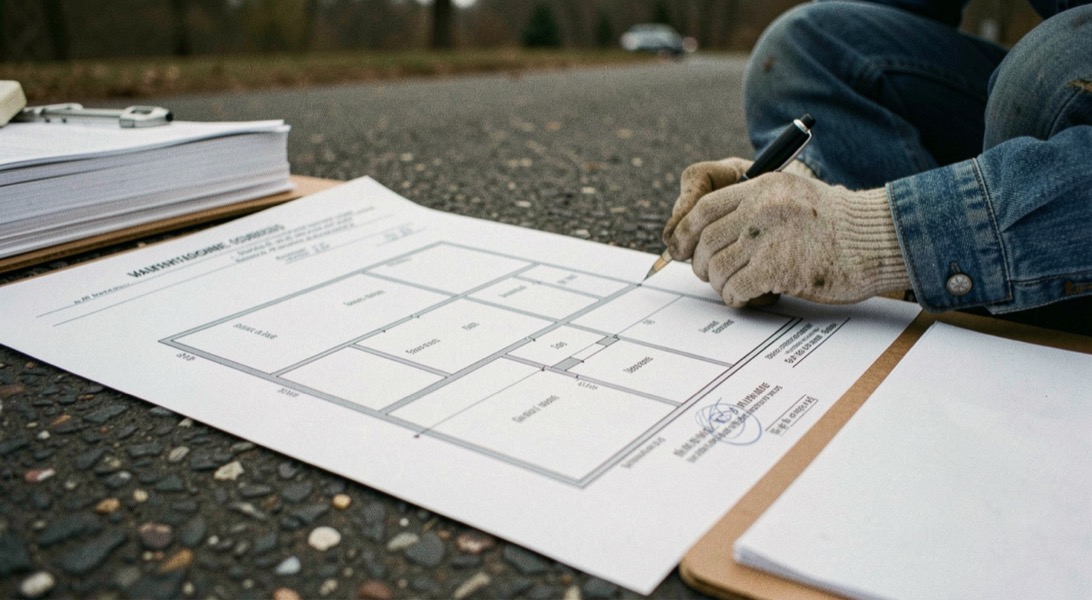
Before a contract is signed, the file should hold the alvara details of the chosen company, the estimate in its final agreed form, the payment schedule, and the drawings or specifications the estimate refers to. If the estimate mentions a document, that document should exist and be attached.
It is also worth confirming that the person signing for the company is entitled to sign. A company's registration shows who represents it. An estimate signed by someone else is not automatically a problem, but it is a question to settle before the contract, not after.
Finally, the contract itself should describe the work in the same terms as the estimate. When the two documents use different words for the same item, the difference becomes an argument later. Aligning them at signature time costs an hour; aligning them during a dispute costs much more.
What the paperwork does not cover
The registers, the alvara, and the estimates answer administrative and financial questions. They do not answer the question of how a company works on site. That is observed in other ways: visits to current jobs, references from previous owners, and the condition of finished work.
Keeping the two categories separate is the point. A company with a valid alvara, the right classes, and a clear estimate has passed the checks that public data can perform. Whether the work is executed well is a separate judgment, made on site, over the course of the job.
For an owner preparing a private building job in Portugal, the sequence is straightforward. Verify the company in the public registers. Read the alvara and its classes against the value and type of the work. Compare estimates on a common grid, with scopes aligned and exclusions read. Then sign, with the file complete.
Checking a contractor in Portugal's public registers answers a question about the person and the licence, not about the asset. The same discipline applies when a property sits in another country: verify the record, then test the numbers. For Rome residential property, district choice comes before everything else, because an evaluation, a mortgage and local taxes each shift the result. A short note on prices, yields and taxes by district sets out the three layers and the method behind them, so a reader can compare areas on stated figures rather than on impressions.